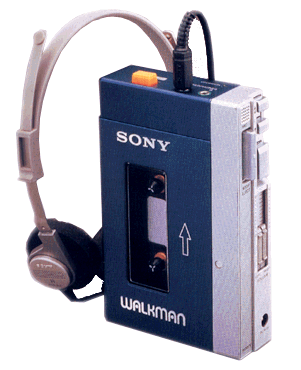
I remember back when I was much younger, even before I owned my first walkman, my grandfather putting on 12" LPs to enjoy what he called "the good music before all this BOOM! BOOM! BOOM!". Apparently, I used to mess with his records a lot because I still have a scar on the big toe of my right foot where Bob Marley's Legend vinyl fell on my toe when I was very young...I was holding the sleeve upside down.
Recently I have found it quite hard to find certain pieces of music on CD or digitally. This happens mostly when I'm looking for a specific recording of a classical piece (particular maestro conducting a particular orchestra) and usually, as luck would have it, I can find it online on vinyl. Well, I shall suffer no longer. The good thing is that this turntable comes with a USB connection to so that you can digitize your vinyls. It plays 33s and 45s and the software has the ability to record 78s. Now, everything is fair game.
Brooklyn Funk Essentials - Vinyl Crisis
"Ev'ry time I hear the heartless sound that has no groove I miss the way you lay on my turntable and move...your flat belly 'gainst the taut tip of my stylus."
In anticipation of the arrival of my new toy, I purchased Charles Mingus' Pithecanthropus Erectus (the "Jackie McLean" Mingus days) online but it has not yet arrived. I bought the "180 gram audiophile virgin vinyl" copy. I'm far from an audiophile, and I wasn't sure what all that entirely meant but I looked it up before purchase (the internet is a beautiful thing) and decided I would give it a go. I also found a vinyl store with an extensive jazz collection about 10 minutes drive from my house so I will be dropping in there very soon to rifle through their jazz sax collection...Hank Mobley, Jackie McLean, Sonny Rollins, Cannonball Adderley.
So, is it just me or is there a general resurgence in interest in vinyl? Well, last month the Nielsen report on music indicated a 37% increase in vinyl sales over last year...for the first quarter of 2011 alone. Whatever the reason, maybe genuine interest, frustration over not being able to find digitized copies of certain music, an attempt to resurrect an old vinyl collection, or just the Rise of the Audiophile, "Black Plastic Magic" is getting a lot more attention these days.
To most, the first mention of classical music invokes images of Mozart and Beethoven and sounds of Für Elise and Moonlight Sonata. For most of my years I was counted in this majority. In time, I came to learn more about and appreciate the music from eras beyond that which is represented by Mozart and Beethoven.
MY START TO CLASSICAL: My first formal introduction to classical music was my freshman year in college. I was dating a girl who played the viola. She had a chair in the school orchestra and was also a member of a string quartet. As such, I would listen to her practice, and attend her performances. At that time however, my ear and mind was not yet tuned correctly so although I enjoyed the music I was not fully understanding it at any level beyond the aesthetics of the music. This changed when I enrolled in a course called Music Appreciation (which was about 70% focused on classical music). Beyond the history of the music and learning about popular pieces and their composers, the most valuable lesson I took away form that class was how to dissect a composition and identify structures and instruments. When I emerged from that class I had a deeper appreciation for, and understanding of classical music and I learned that I absolutely loved Baroque music.
BAROQUE ERA: Before the invention of the modern piano, which became one of the major instruments of the Classical and Romantic eras, there was the harpsichord and the Baroque period. Even if you may not be aware of the distinctions between the musical eras, you can probably say "AH HA!" to at least these two famous Baroque era pieces - Pachelbel's Canon in D Major and Air on the G String. The Baroque era is the period in European music that preceded the Classical era, spanning from 1600 to about the mid-1700s. Some of the more popular composers of the Baroque are Antonio Vivaldi (composer of The Four Seasons), George Frideric Handel, Henry Purcell, Claudio Monteverdi, and Johann Sebastian Bach. Bach is recognized as not just the most dominant composer of the Baroque era but also one of the greatest composers of all time. Bach didn't just compose music because he knew how to do it; he treated it as a subject to explore and used his compositions as tools to probe some of the more technical aspects of it. One example of this is his examination and development of counterpoint. Counterpoint is where two or more lines of music (voices) that are independent in rhythm and harmony happen at the same time that blends harmonically. You can see it demonstrated and explained at length by Anthony Tommasini.
THE ART OF FUGUE: Bach dedicated a whole work (unfinished) to the exploration of counterpoint - The Art of Fugue - which is what I intend to share. The fugue was a popular Baroque form that relies on the contrapuntal argument. The Art of Fugue is a work which contains 14 movements labeled Contrapunctus I - Contrapunctus XIV where the contrapuntal complexity increases with each movement. The final one, Contrapuctus XIV, is unfinished and is thought to be so because of carelessness on the part of the publishers since Bach himself was supervising the preparations for publication. Contrapunctus IV, which is the last of the "simple fugues", is one which is complex enough to engage and keep your interest but not so complex that you get lost after 30 seconds. The following recording is done by the Emerson String Quartet (2 violins, 1 viola, 1 cello).
The Art of Fugue, Contrapunctus IV - J.S. Bach (composer) - Emerson String Quartet
As Bach himself was quite an accomplished organist and harpsichordist, it is sometimes suggested that The Art of Fugue was intently written for keyboard instruments. However, Malcolm Boyd writes that "Bach's intentions in this respect [regarding instrumentation] are by no means clear, and indeed it seems that the medium of performance - one might even say performance itself - was of minor importance to him. No instrument at all is mentioned in either the manuscript or the printed sources of The Art of Fugue." Despite this there are some pretty good arguments for intent as a keyboard work (the first may have been published by Gustav Leonhardt in 1953 in The Musical Quarterly) including the range of the voices being beyond that of any ensemble instrument in Bach's day, and greater similarities to his organ/harpsichord works compared to his ensemble pieces. Leonhardt even writes that "to Bach, who was a practitioner and not a theorist, the thought that any piece of music might not be intended to sound would have seemed ludicrous and blasphemous...and in writing the fugues of this word he mostly respected, deliberately or unconsciously, the limitations of two hands on a keyboard."
Regardless, as you can see from the rendition above, it is easily amenable to other classes of instruments (and have been arranged for everything from organ to strings to brass - even the saxophone) while maintaining is depth, technicality, and aesthetics...another feature that makes it a great work and suggests that Bach was more concerned with exploring the technicalities of contrapuntal writing rather than composing for a performance. In other words, it was to be studied, not performed.
In terms of interpretation, Glenn Gould is considered one of the foremost pianists on the subject of Bach. Here he is playing Contrapunctus IV on the piano.
And here discussing The Art of Fugue in an interview:
There's nothing else I can say after Gould has spoken except that if you like Baroque music then you should get your ears on the entire work of The Art of Fugue.
"Wonderland was created just like a short cut movie,
with a taste of adventure, in a dream land hosted by
an elegant cat, in a short 24h time." - Teru
Last night, rather serendipitously, I came upon a guy who goes by the name Dandy Teru and a few clicks later I was delightfully introduced to Massive Suits Quartet. According to his facebook page he is interested in music, women, and suits...already my type of character. Beyond that, the most I have been able to find out about him is that he is a French producer and self-proclaimed dandy that performed, produced, and mixed the music that you are about to hear. Teru described Massive Suit Quartet's work as "creating sounds with jazz breaks, samples, piano keys, and arranements science"..."with a touch of romanticism, elegance, and drama". This one is called "Costume".
Michael Jackson made the funkiest attire look super cool
Who among us didn't tireless try to perfect the moonwalk after seeing the dancing phenom execute it with such ease? Definitely one of the top 10 pop musicians of all time, Michael Jackson needs no background introduction. Today marks the two-year memorial of his death and so I'm taking this time out to commemorate his greatness. So bust out the old vinyls, cassette tapes, mp3s or YouTube videos and just enjoy some MJ.
Michael Jackson performing "Billy Jean" at Motown 25

 In anticipation of the arrival of my new toy, I purchased Charles Mingus' Pithecanthropus Erectus (the "Jackie McLean" Mingus days) online but it has not yet arrived. I bought the "180 gram audiophile virgin vinyl" copy. I'm far from an audiophile, and I wasn't sure what all that entirely meant but I looked it up before purchase (the internet is a beautiful thing) and decided I would give it a go. I also found a vinyl store with an extensive jazz collection about 10 minutes drive from my house so I will be dropping in there very soon to rifle through their jazz sax collection...Hank Mobley, Jackie McLean, Sonny Rollins, Cannonball Adderley.